Russische Forschungsstation in der östlichen Antarktis

Wetterlexikon: Wostok
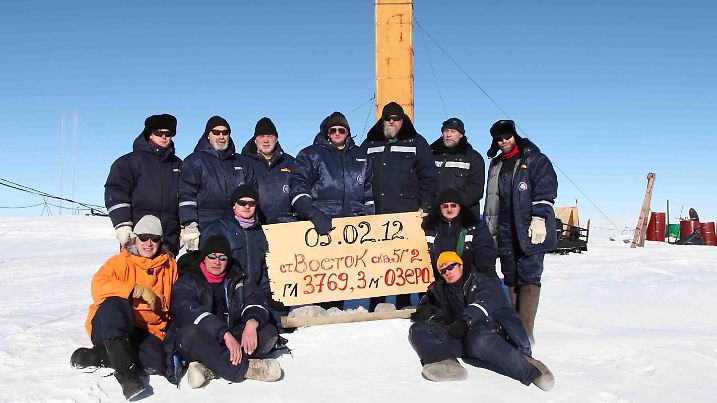
epa03097478 A handout picture dated 06 February 2012 provided by the Arctic and Antarctic Research Institute of St. Petersburg shows Russian researchers posing for a picture in front of the drilling tower at the Vostok station in Antarctica after reaching the subglacial lake Vostok. Russian drillers have reached a massive lake under the Antarctic ice cap that had been sealed off from the rest of the world for a half million years, the Ministry of Natural Resources announced 08 February, according to Itar-Tass news agency. Scientists broke through the Antarctic ice sheet to tap into Lake Vostok's waters at a depth of 3,769.3 metres. Drilling began in the 1970s. The ice sheet covering Antarctica's surface is believed to be some 500,000 years old. Russia media described the breakthrough as the most significant event in Antarctic exploration in a century. An ice core sample was recovered during the drilling. Vostok Lake is roughly similar in size to the US-Canadian Lake Ontario, according to Russian estimates. Lake Vostok's water may have been isolated from the rest of the Earth's environment for as long as 25 million years, according to some estimates. Scientists hope that analysis of the ice core, as well as findings by a remote-controlled robot to be sent into the lake, will give a new window on the state of the Earth's environment during the Pleistocene era, a period sometimes referred to as the Ice Age. The liquid lake, which lies on the bedrock below Antarctica's permanent ice sheet, could contain microorganisms millions of years old, the report said. EPA/ARCTIC AND ANTARCTIC RESEARCH INSTITUTE PRESS SERVICE HANDOUT EDITORIAL USE ONLY/NO SALES |
Die Wostok-Station ist eine am 16. Dezember 1957 eröffnete früher sowjetische, heute russische Forschungsstation in der Ostantarktis.

Mit der Wostok-Station ist eine russische Forschungsstation in der östlichen Antarktis, die der Erforschung des irdischen Klimas dient, gemeint. Die Station, knapp 1.300 Kilometer vom geografischen Südpol entfernt, war 1957 von der Sowjetunion im Wilkesland eröffnet worden. 1.260 Kilometer trennen sie von der nächstgelegenen Küste; bis zur Mirny-Versorgungsstation sind es etwa 1.400 Kilometer.

Wostok - „Kältepol der Erde“ mit satten -89,2 Grad

Einer der Forschungsschwerpunkte der vor Ort arbeitenden Wissenschaftler befindet sich 3.750 Meter unter der Station: der Wostok-See, ein Süßwassersee zwischen Gletschereis und Felsengrund. Im Jahr 1990 wurde ein Bohrkern aus dem Eis unmittelbar über dem See gewonnen, der Informationen aus 420.000 Jahren Erdgeschichte lieferte.

Die Wostok-Station ist bekannt für ihre extrem niedrigen Temperaturen, was ihr den Namen „Kältepol der Erde“ einbrachte. Am 21. Juli 1983 lag die Temperatur bei −89,2°, die bisher tiefste gemessene Lufttemperatur auf der Erde.